Mabamba Swamp Uganda – Shoebill Watching and Birding
WRITTEN BY
Shoebill Watch Team
DATE
November 9, 2026
Mabamba Swamp Uganda: The Complete Guide to Shoebill Watching and Birding
On the northern shores of Lake Victoria, not far from Entebbe, lies one of Uganda's most remarkable birdwatching destinations. Mabamba Swamp is a vast stretch of papyrus, shallow waterways and open pools where visitors come in search of a bird unlike any other: the shoebill.
For many birdwatchers travelling to Uganda, seeing a shoebill in the wild is high on the list of things they hope to experience. Its enormous bill, striking grey plumage and almost motionless hunting style have made it one of Africa's most recognisable birds. Yet finding one requires patience, suitable habitat and a little luck.
Mabamba offers an opportunity to make that search without travelling far from Entebbe or Kampala. Visitors explore the wetland in small wooden boats, following narrow channels through the papyrus while local guides scan the vegetation for shoebills and other birds.
But Mabamba is much more than a place to tick one bird off a checklist. It is an important freshwater ecosystem, a source of livelihood for surrounding communities and a fascinating destination for anyone interested in Uganda's natural heritage.
This guide explores what makes Mabamba special, the birds you may encounter, how shoebill watching works and what you should know before planning a visit.
Where Is Mabamba Swamp Located?
Mabamba Swamp, officially known as the Mabamba Bay Wetland System, lies along the northern shores of Lake Victoria in central Uganda, west of Entebbe International Airport.
The wetland extends across parts of Wakiso and Mpigi districts and is connected to the wider Lake Victoria ecosystem. Its landscape consists of extensive papyrus beds, narrow channels, floating vegetation, shallow pools and open water.
Although Mabamba is relatively close to Entebbe, the experience feels very different from the busy towns and roads surrounding Lake Victoria.
Once you enter the wetland, the sounds of traffic give way to birds calling from the reeds, water moving gently against the boat and the occasional activity of fishermen working along the channels.
Most visitors reach Mabamba from Entebbe, although day trips can also be arranged from Kampala. Depending on the starting point and travel arrangements, the wetland can be reached by road or by boat across part of Lake Victoria.
Its accessibility makes Mabamba particularly attractive to travellers who have a morning or afternoon available before continuing to other destinations in Uganda.
Why Is Mabamba Swamp Famous?
Mabamba is best known for its shoebills, but its importance extends far beyond a single species.
The wetland is internationally recognised as an Important Bird and Biodiversity Area and was designated a Ramsar Wetland of International Importance in September 2006.
This recognition reflects the importance of Mabamba's habitats for resident waterbirds, migratory species and birds of conservation concern.
The wetland provides feeding and sheltering areas for numerous species, including shoebills, papyrus-associated birds, herons, kingfishers and seasonal migrants.
Its vegetation also supports aquatic life and helps maintain the ecological health of the surrounding Lake Victoria environment.
For birdwatchers, Mabamba is especially valuable because it offers an opportunity to explore a large wetland habitat with experienced local guides who understand the movements and behaviour of its birds.
For surrounding communities, the wetland supports fishing, tourism and other livelihoods.
These different roles make Mabamba both an important conservation area and a place where the relationship between people and nature is visible every day.
The Shoebill: Mabamba's Most Famous Bird
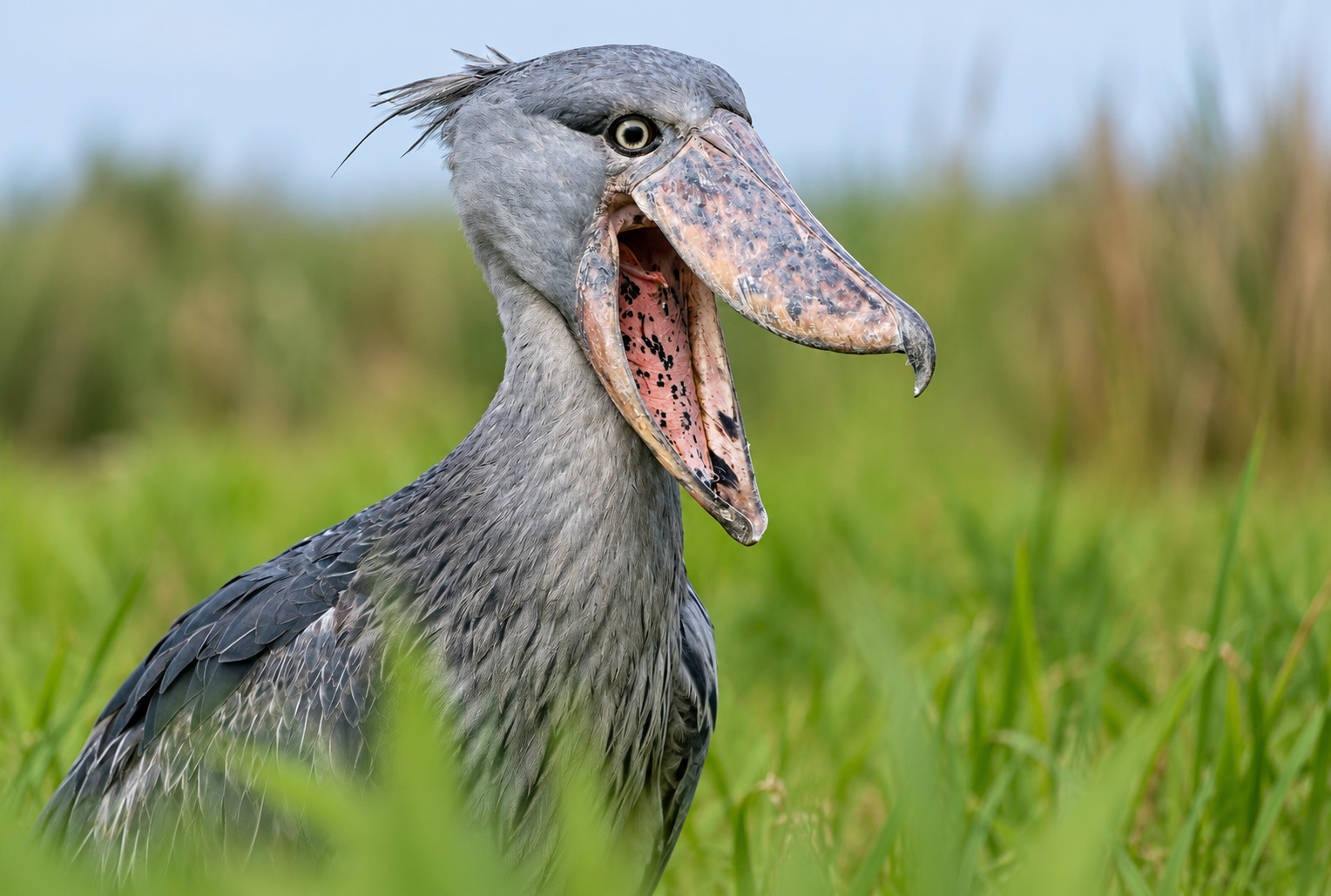
There is something extraordinary about seeing a shoebill for the first time.
Standing tall among the papyrus, with its broad bill and watchful expression, the bird looks almost prehistoric. Unlike the more active herons and egrets that share its habitat, a shoebill can remain completely still for long periods.
The shoebill, scientifically known as Balaeniceps rex, is a large wetland bird found in parts of tropical East and Central Africa.
Its name comes from the unusual shape of its bill, which resembles a large wooden shoe. The bill is powerful, broad and well adapted for catching aquatic prey.
Shoebills are generally solitary birds and are most closely associated with extensive freshwater wetlands, particularly areas with papyrus, reeds and shallow pools.
How Does a Shoebill Hunt?
One of the most fascinating aspects of shoebill behaviour is its hunting technique.
Rather than actively chasing fish through the water, a shoebill often waits almost motionless, watching the surface for signs of movement.
When suitable prey comes within reach, the bird strikes suddenly, using its enormous bill to capture the animal.
Lungfish are an important part of its diet, although shoebills also feed on other fish and aquatic animals.
This patient hunting behaviour is one reason shoebills can be surprisingly difficult to locate, even in places where they are regularly recorded.
A bird standing quietly among dense vegetation can blend into the surrounding wetland, especially when viewed from a distance.
Why Is the Shoebill Considered Special?
For birdwatchers, the shoebill is special because of its distinctive appearance, unusual behaviour and relatively limited distribution.
It is also a species of conservation concern, classified as Vulnerable on the IUCN Red List.
Its survival depends on the protection of large freshwater wetlands, many of which face pressure from habitat loss, disturbance and changes in land use.
Watching a shoebill in Mabamba is therefore not simply an opportunity to photograph an unusual bird. It is also a chance to appreciate the importance of protecting the wetland habitats on which the species depends.
Shoebill Watching at Mabamba Swamp: What to Expect
The main way to explore Mabamba is by taking a guided boat excursion through the wetland.
Visitors usually begin at a local landing site, where they meet their boat guide and board a small wooden canoe or motorised boat.
Before departure, the guide explains the route, the expected conditions and the basic safety requirements.
Once on the water, the boat moves slowly through narrow channels surrounded by papyrus vegetation.
Some sections are enclosed by tall reeds, while others open into shallow pools where aquatic plants cover the water's surface.
Your guide will carefully scan the wetland for shoebills, looking for movement, feeding activity or the distinctive outline of a bird standing among the vegetation.
The search may take only a short time, or it may require exploring several different channels.
There is no fixed point where a shoebill will always be waiting.
The birds move naturally through the wetland, and their location can change according to feeding conditions, water levels and disturbance.
The Moment You Find a Shoebill
When a shoebill is located, the boat guide will usually slow down and choose a suitable viewing position.
This is the moment many visitors have travelled to Mabamba to experience.
You may see the bird standing quietly in shallow water, carefully watching for prey. Sometimes it may move slowly through the vegetation, stretch its wings or change its position.
If you are fortunate, you might witness the sudden movement of a shoebill striking at a fish.
Photographers often appreciate the opportunity to observe the bird against the natural background of papyrus and water.
However, it is important to remember that shoebills are wild animals.
The boat should remain at a respectful distance, and visitors should avoid making loud noises or encouraging the guide to approach too closely.
A good shoebill encounter is one in which the bird continues its natural behaviour without being disturbed.
How Long Does Shoebill Watching Take?
The boat excursion commonly takes around one to three hours, depending on the arrangement, weather, water conditions and the amount of time spent searching for birds.
Dedicated birdwatchers and photographers may prefer a longer visit to allow more time for observing other wetland species.
Travellers coming from Entebbe can usually plan Mabamba as a half-day excursion, while those travelling from Kampala should allow additional time for road transfers.
Birds of Mabamba Swamp Beyond the Shoebill
Although the shoebill attracts most of the attention, Mabamba offers rewarding birdwatching for visitors interested in wetland birds and papyrus specialists.
The wetland supports a wide variety of resident and migratory species, and the birds encountered can vary considerably depending on the season, habitat and weather.
Papyrus Gonolek
The Papyrus Gonolek is one of the most distinctive birds associated with the papyrus wetlands around Lake Victoria.
Its striking black and red plumage makes it an attractive species for birdwatchers, although it can be difficult to observe because it often remains concealed within dense vegetation.
Visitors may hear its calls before seeing the bird itself.
African Jacana
The African Jacana is a familiar sight in suitable freshwater habitats.
Its unusually long toes allow it to walk across floating vegetation, giving the impression that it is moving across the water's surface.
Jacanas are particularly interesting to watch as they search for food among water lilies and other aquatic plants.
Malachite Kingfisher
Small, colourful and often perched close to the water, the Malachite Kingfisher is a favourite among bird photographers.
Its bright blue upperparts and warm orange underparts stand out beautifully against the green vegetation of the wetland.
The bird may be seen watching the water before diving to catch small aquatic prey.
African Pygmy Goose
The African Pygmy Goose is a small, beautifully patterned waterbird associated with freshwater habitats containing floating vegetation.
It can be encountered in suitable areas of Mabamba, although sightings depend on local conditions.
Blue-breasted Bee-eater
The Blue-breasted Bee-eater is another attractive species associated with wetland vegetation.
It feeds on flying insects and may be seen perched on reeds or making short flights to catch prey.
Other Birds to Look For
Additional birds that may be encountered around Mabamba include: Pied Kingfisher, Black Crake, Purple Heron, Goliath Heron, Squacco Heron, Long-toed Lapwing, African Fish Eagle, White-faced Whistling Duck, Carruthers's Cisticola, Winding Cisticola, African Marsh Harrier, White-winged Tern, Various egrets, cormorants and migratory shorebirds
Some species are more regularly observed than others, while certain migrants are present only during particular times of the year.
For serious birdwatchers, Mabamba is worth visiting even if the shoebill is not located.
The variety of habitats and the opportunity to search for papyrus-associated birds make it an interesting destination in its own right.
Best Time to Visit Mabamba Swamp for Shoebill Watching
Mabamba can be visited throughout the year, and shoebill-watching excursions are not restricted to a single season.
However, the experience can vary with rainfall, water levels, weather and bird activity.
Morning Birdwatching
Early morning is generally a good time to begin a visit.
Temperatures are often cooler, the light can be favourable for photography and many wetland birds are active during the earlier hours of the day.
A morning excursion also leaves time for other activities around Entebbe later in the day.
Visiting During the Drier Months
Uganda's generally drier periods, particularly from December to February and June to August, can provide more comfortable travel conditions.
Road access may be easier, and visitors may encounter fewer weather-related interruptions.
However, water levels and shoebill movements are influenced by local conditions, so a dry-season visit does not automatically guarantee better sightings.
Visiting During the Rainy Months
Mabamba remains an interesting destination during wetter periods.
The wetland can be particularly green, and overcast skies may provide soft light for photography.
Heavy rain, strong winds or thunderstorms can sometimes delay or interrupt boat excursions.
Visitors should therefore allow some flexibility in their schedules.
Is Shoebill Watching Guaranteed?
No, Although Mabamba is one of Uganda's established shoebill-watching destinations, sightings are never guaranteed.
Shoebills move freely through the wetland, and their location depends on natural conditions.
An experienced guide can improve the quality of the search, but no guide can control where a wild bird will appear.
How to Get to Mabamba Swamp from Entebbe and Kampala
Mabamba is accessible from both Entebbe and Kampala, making it a convenient destination for short birdwatching excursions.
By Road from Entebbe
The most common option is to travel by road from Entebbe to the Mabamba landing area.
The route passes through local communities and rural landscapes before reaching the wetland.
Depending on the starting point, road conditions and traffic, the journey generally takes around one to one and a half hours.
Some sections of the access road may be rough, particularly after heavy rainfall.
By Boat from Entebbe
Mabamba can also be reached through a boat transfer across Lake Victoria.
This option offers a different perspective of the lakeshore and can reduce the amount of road travel, depending on the departure point.
The transfer normally requires suitable boat arrangements, followed by a smaller wetland boat for navigating the shallow papyrus channels.
Boat travel depends on weather, lake conditions and operator availability.
From Kampala
Visitors staying in Kampala can arrange a day trip to Mabamba by road.
Because Kampala is farther from the wetland and traffic can affect journey times, an early departure is recommended.
A visit from Kampala may take most of the morning or longer once transfers and birdwatching are included.
Other Things to Do Around Mabamba Swamp
Shoebill watching is the main attraction, but the surrounding area offers additional opportunities for nature observation and local experiences.
General Wetland Birdwatching
Birdwatchers can spend additional time exploring different sections of the wetland and nearby habitats.
The variety of birds makes Mabamba suitable for both introductory birdwatching and more focused species searches.
Wildlife Photography
The combination of birds, papyrus vegetation, open water and changing light creates interesting photographic opportunities.
A private excursion can be particularly useful for photographers who prefer to spend more time observing individual subjects.
Community and Fishing Village Experiences
The communities around Mabamba have long depended on Lake Victoria and its wetlands for their livelihoods.
With appropriate local arrangements, visitors may learn about fishing activities, wetland resources and the role of community-based tourism.
These experiences should be conducted respectfully and with the consent of the people involved.
Exploring Entebbe
Because Mabamba is close to Entebbe, the excursion can be combined with other activities in the area.
Visitors may consider the Entebbe Botanical Gardens, the Uganda Wildlife Education Centre or time relaxing along the shores of Lake Victoria.
Conservation and the Importance of Mabamba Wetland
Mabamba is more than a tourism destination.
It is an important freshwater ecosystem that supports birds, fish, aquatic plants and surrounding communities.
The wetland helps maintain ecological processes associated with Lake Victoria, including water filtration, habitat provision and the storage of water during periods of high rainfall.
Its international recognition reflects the importance of protecting these habitats.
Threats Facing Mabamba Swamp
Like many wetlands around Lake Victoria, Mabamba faces pressures linked to human activity and environmental change.
These may include:
- Conversion of wetland areas for agriculture and settlement.
- Unsustainable harvesting of wetland resources.
- Pollution and changes in water quality.
- Disturbance to sensitive wildlife habitats.
- Changes in water levels and vegetation.
- Increasing pressure on fisheries and other natural resources.
Protecting the wetland requires cooperation between local communities, conservation organisations, government authorities and tourism operators.
How Responsible Tourism Can Help
Well-managed tourism can create economic opportunities while encouraging the protection of natural habitats.
Local boat guides, birding guides and other service providers benefit when visitors choose responsible excursions.
Visitors can contribute by following wildlife-viewing guidelines, avoiding litter, respecting local communities and supporting operators who prioritise conservation.
For a species such as the shoebill, protecting suitable wetland habitat is essential to its long-term survival.
Mabamba Swamp Photography Tips
Mabamba is particularly attractive to bird photographers because many encounters take place from a boat.
However, photographing wildlife from a moving boat requires some preparation.
A telephoto lens is useful for photographing birds without approaching too closely. A camera or lens with effective image stabilisation can also help when shooting from an unstable position.
Early morning light may provide attractive conditions, although overcast weather can also produce useful results.
It is advisable to carry a waterproof camera bag or protective cover, as water splashes and sudden rain showers are possible.
Photographers should remain seated when instructed and avoid sudden movements that could destabilise the boat.
Flash photography, baiting and deliberate disturbance of birds should be avoided.
The best wildlife photographs often come from allowing animals to behave naturally rather than trying to force a particular encounter.
What to Pack for a Mabamba Swamp Birding Trip
A little preparation can make the excursion more comfortable.
Useful items include:
- Binoculars for observing distant birds.
- A camera and suitable telephoto lens.
- A lightweight rain jacket.
- Comfortable, breathable clothing in neutral colours.
- A hat and sunscreen.
- Insect repellent.
- Drinking water.
- A waterproof bag for electronics and valuables.
- A notebook or bird checklist.
Visitors should wear suitable footwear for boarding and disembarking from small boats.
Life jackets should be worn during the boat excursion, and all safety instructions from the guide and boat operator should be followed.
Can You Combine Mabamba Swamp with a Uganda Safari?
Yes. Mabamba is an excellent addition to a longer Uganda safari, particularly for travellers arriving through Entebbe International Airport.
A half-day visit can be arranged at the beginning or end of a journey, depending on flight schedules and available time.
Mabamba Swamp and Gorilla Trekking in Bwindi
One popular combination is a visit to Mabamba followed by gorilla trekking in Bwindi Impenetrable National Park.
This itinerary brings together two very different wildlife experiences: searching for a remarkable wetland bird and observing mountain gorillas in a tropical rainforest.
Mabamba Swamp and Uganda Birding Safaris
Dedicated birdwatchers can combine Mabamba with destinations such as Mabira Forest, Kibale National Park, Semuliki National Park, Queen Elizabeth National Park and Bwindi Impenetrable National Park.
Each destination offers different habitats and bird species, creating opportunities for a varied birding itinerary.
Mabamba Swamp and Wildlife Safaris
Mabamba can also be included in a broader wildlife safari visiting Uganda's savannah national parks.
Murchison Falls National Park, Queen Elizabeth National Park and Lake Mburo National Park offer opportunities to observe mammals, waterbirds and a wide range of other wildlife.
Frequently Asked Questions About Mabamba Swamp
Where is Mabamba Swamp in Uganda?
Mabamba Swamp is located along the northern shores of Lake Victoria, west of Entebbe, in central Uganda. The wetland extends across parts of Wakiso and Mpigi districts.
Why is Mabamba Swamp famous?
Mabamba is particularly famous for shoebill watching. It is also an internationally recognised wetland supporting numerous resident and migratory bird species.
Can you see shoebills at Mabamba Swamp?
Yes. Mabamba is one of Uganda's best-known locations for searching for shoebills in their natural habitat. However, sightings are not guaranteed.
How far is Mabamba Swamp from Entebbe?
The wetland is relatively close to Entebbe, although the road journey follows a longer route around parts of the lakeshore. Travel commonly takes around one to one and a half hours, depending on the departure point and road conditions.
How long should I spend at Mabamba Swamp?
A half-day excursion is sufficient for many visitors, particularly those focusing on shoebill watching. Dedicated birdwatchers and photographers may prefer additional time.
Is Mabamba Swamp suitable for beginners?
Yes. Mabamba is suitable for both experienced birdwatchers and visitors who have never been on a birding excursion. A knowledgeable guide can help identify species and explain their behaviour.
Is Mabamba Swamp safe to visit?
Mabamba can be visited through organised excursions with experienced local guides and suitable boats. Visitors should wear life jackets, follow safety instructions and avoid boat trips during unsafe weather conditions.
What is the best time of day for shoebill watching?
Early morning is generally recommended because of cooler temperatures and favourable birdwatching conditions. Shoebills may also be encountered at other times of the day.
Can I visit Mabamba Swamp from Kampala?
Yes. Mabamba can be visited from Kampala, although travel takes longer than from Entebbe. An early departure is advisable.
Is Mabamba Swamp worth visiting if I am not a birdwatcher?
Yes. The peaceful wetland landscape, boat experience and opportunity to observe unusual wildlife make Mabamba interesting even for visitors without specialist birdwatching knowledge.
Plan Your Mabamba Swamp Birding Experience with Shoebill Watch
Mabamba Swamp offers something increasingly rare in modern travel: the opportunity to slow down and experience wildlife in a natural, relatively quiet setting.
At Shoebill Watch, we help travellers plan guided shoebill-watching excursions and private Uganda birding safaris based on their interests, travel dates and available time.
Explore our Half-Day Mabamba Swamp Shoebill Watching Tour, or combine Mabamba with a longer journey to Bwindi Impenetrable National Park and other wildlife destinations.